The AI Token Economy
AI can give you and the people you lead super powers, but it comes with hidden managing responsibilities you didn't sign up for.
AI can give you and the people you lead super powers, but it comes with hidden managing responsibilities you didn't sign up for.
Thought experiment: Imagine you're assigned a freelancer with these weird characteristics.
On paper, this collaborator arrives with encyclopedic knowledge, works instantly, and accepts tasks without hesitation. But they carry three peculiar flaws.
Knows about everything you ask them, and can produce results fast without breaks.
No task too big or too niche — it will take a swing at whatever you hand it.
Never stops, never sleeps, unless you stop paying.

Takes tasks literally, fills gaps with assumptions, never pushes back.
No flat day rate. Every prompt, tool call, and correction adds to the tab.
Every new conversation starts from zero. Yesterday’s work never happened.
It's an LLM — but if it were a human, how would you manage it?
Directing an AI agent requires the same delegation and review rigor as onboarding an external specialist.
door 1 · the individual
5–20× individual throughput by directing synthetic labor.
door 2 · the organization
Upskilling whole teams into fluent directors of automated systems.
New technology gives rise to new disciplines for humans to cope.
From Prompt Engineering in 2023 to Context Engineering in 2024, Harness Engineering in 2025, and Token Economics today.
chat workflow
Phrasing, few-shot examples, and asking clearly.
agentic workflow
AGENTS.md, skills, and compact structured memory.
autonomous workflow
Tools, deterministic tests, and guardrail verification.
emerging
Self-improving autonomous feedback cycles.
Token Economy — the currency of every era
For a real freelancer you need a business case. AI just bills you.
A €3,200 consultant invoice requires purchase orders and approvals. AI accumulates identical costs silently across thousands of micro-prompts.
You're now accountable for a budget you never signed up to manage.
Defaulting to flagship frontier models for routine chores burns capital. The economic winner optimizes outcome per euro.
Outcome per euro
At 93%, both models clear the bar — the cheaper one wins ≈5× outcome per euro.
Today’s prices are subsidized — vendors sell intelligence below cost to build adoption. When subsidies expire, outcome per euro decides who survives.
Tokens are the basic unit of data for LLMs — every one is billed.
LLMs calculate statistical probabilities over numerical tokens. Every word, character, and prompt translates to billable units.
Every token is billed 4 ways
Most tools hide the meter — this is what seeing it looks like.
A typical 200k session breakdown: system prompts, conversation history, tool payloads, and retrieved documentation.
The meter is hidden on purpose.
Obscurity is a product pattern: frictionless initiation, habitual workflows, and surprising monthly invoices.
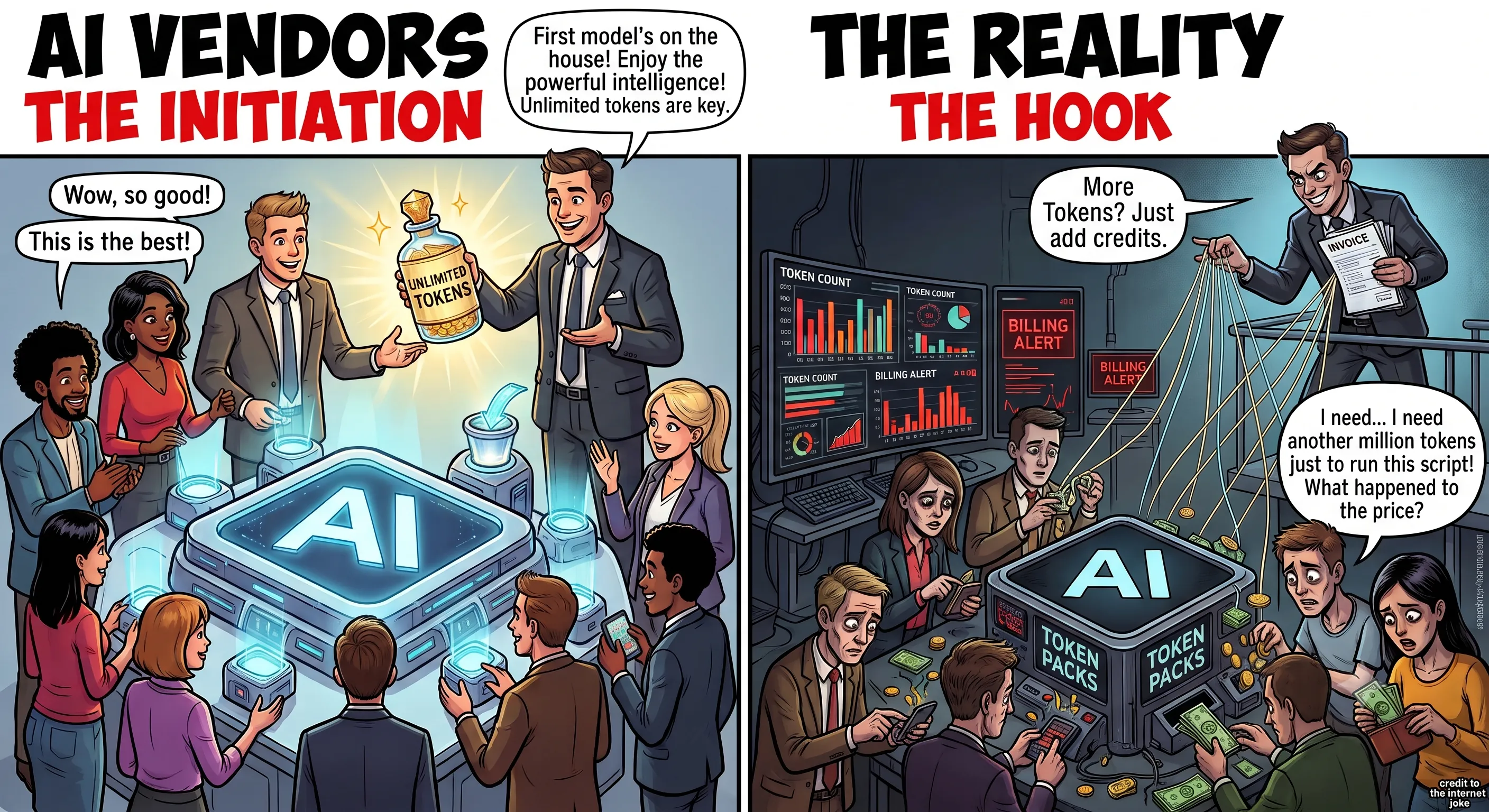
Unlimited on the house. The intelligence feels like magic and the bill is invisible — so you build the habit.
Now you are fluent — and the meter is gone. Out of credits? Just top up. The real rate never shows.
Context window is the model's attention span.
Tokens accumulate in the context window. As the window fills, attention degrades and critical instructions slip away.
How key instructions get lost in the middle.
Models attend sharply to the start and end of context, but the middle blurs into an attention valley.
Past ~half full, the model starts losing the plot.
Below 50% is the smart zone. Above 50%, accuracy degrades. Above 75%, hallucination risk spikes. Three levers: Monitor, Compact, Hand off.
Watch the gauge before it degrades — catch it while it is still grounded.
Summarize where you are into a clean handoff, then start fresh from it.
One small bug fix compounds to ~73,000 tokens of context.
Agentic loops re-transmit the entire conversation history on every single tool call and reflection step.
The same bug fix, priced across models.
You are billed for tokens processed on every turn, not window capacity. A routine bug fix produces a 14× price swing across models.
~14× spread for identical output. At 50 fixes a day, that is roughly $6 vs $77 per developer per day — before anyone has shipped a single feature. This is why model routing matters.
My real model stack: one workflow, many models.
Route each phase to the most economical capable model: flat-rate chats for ideation, frontier reasoning for architecture, fast models for code execution.
Web chat · flat-rate
Claude Code CLI · Desktop
All CLI
Three levers to improve your token economy
Combine automated tooling (rtk, compression, linting) with structural context steering and disciplined team habits (edit don't append, session hygiene).